
How to Crochet a Daisy — Free Beginner Pattern
What you need
- Makes: One daisy, roughly 6–7 cm across
- Yarn: Any DK or worsted cotton — a small amount of yellow and white
- Hook: 3.5 mm (E/4) for DK, 4 mm (G/6) for worsted
- Yarn needle for weaving in ends
- Scissors
Abbreviations (US terms)
- ch chain
- sl st slip stitch
- sc single crochet
- hdc half double crochet
- dc double crochet
- st(s) stitch(es)
- rnd round
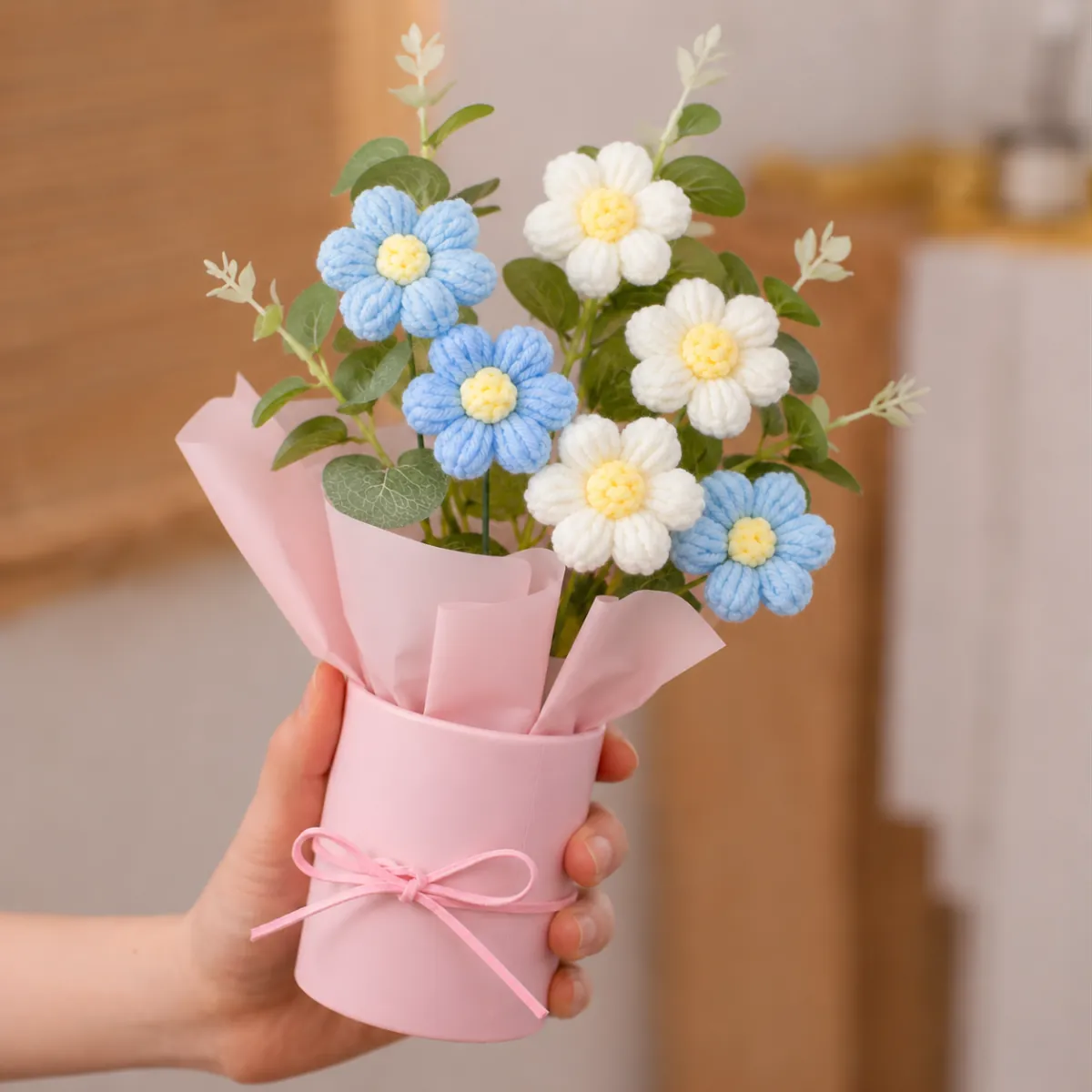
The daisy is the flower to learn first. It uses four stitches you probably already know, it is worked in two rounds, and a finished bloom takes about ten minutes once you have made one or two. It is also the most useful flower to be able to make — a handful of daisies will cover a hairband, a bag, a card, a garland, or the beginnings of a bouquet.
This pattern is written in US crochet terms. If you learned in UK terms, the conversion is: our sc is your dc, our hdc is your htr, our dc is your tr.
Before you start
Two things make the difference between a daisy that sits flat and one that curls:
- Keep your tension loose on the petal round. Tight double crochets pull the petal into a cup. If your flower is domed rather than flat, that is almost always the cause.
- Use cotton rather than acrylic if you have it. Cotton holds a crisp petal shape; acrylic goes soft and rounded. Neither is wrong, but cotton looks more like a flower.
If you cannot work a magic ring yet, substitute ch 4 and join with a sl st
to form a small circle, then work Rnd 1 into that circle. The centre hole will
be slightly larger, which nobody will notice.
The pattern
Centre — in yellow
Rnd 1: Make a magic ring. Ch 1, then work 10 sc into the ring. Pull the tail firmly to close the centre. Sl st into the first sc to join. (10 sc)
Fasten off yellow, leaving a short tail to weave in later.
Petals — in white
Rnd 2: Join white with a sl st in any st. Ch 1, sc in the same st.
Now: *ch 5, skip 1 st, sc in the next st.* Repeat from * to * three more times. Then ch 5, skip the last st, and sl st into the first sc to join. (5 ch-5 loops)
Take a second here and count your loops before moving on. Five is what you want. Four or six means a stitch was skipped or doubled somewhere in the round, and it is much easier to fix now than after the petals are on.
Rnd 3: Into each ch-5 loop, work: (sc, hdc, 3 dc, hdc, sc) — seven stitches, all into the same loop. Then sl st into the next sc of Rnd 2 (the stitch sitting between two loops) before starting the next petal.
Repeat all the way around. Join with a sl st into the first sc of the round and fasten off, leaving a tail if you plan to sew the daisy onto something. (5 petals)
Finishing
Weave in both ends with a yarn needle, working them along the back of the stitches rather than across the middle so nothing shows from the front. If the petals sit unevenly, pinch each one flat between your fingers and give the flower a light press under a damp cloth — cotton will hold the shape once dry.
Troubleshooting
My daisy curls into a bowl. Your petal stitches are too tight, or you worked more than 3 dc in a loop. Go up a hook size and try again.
The centre has a hole in it. The magic ring was not pulled fully closed before joining. Thread the starting tail onto a needle and cinch it from the back.
The petals overlap each other. You have too many petals for the centre — check that Rnd 2 produced exactly 5 loops, not 6.
Making it bigger, smaller, or fuller
- Bigger daisy: work
12 scinto the magic ring in Rnd 1 and make 6 loops in Rnd 2 (ch 5, skip 1, sc in nextaround). - Longer, thinner petals: use
ch 6loops in Rnd 2 and work(sc, hdc, 5 dc, hdc, sc)into each one in Rnd 3. - Double-layered daisy: make two flowers, one slightly larger, and stitch them together through the centres with the petals offset.
Turning daisies into a bouquet
A single daisy is a decoration. Five to nine of them on stems, wrapped properly, is a gift — and the wrapping is what makes the difference between the two. Our guide to turning crochet flowers into a bouquet covers stems, a matching leaf pattern and how to wrap the finished bunch.
If daisies are your thing, the crochet sunflower pattern uses the same construction with a bigger centre, so it is the natural one to make next.